 ORHAR
Natural Voice
Smooth Scripture reading with respectful, clear intonation for every chapter.
Taste the App · Interactive Experience
Explore ORHAR through real interactive modules: cinematic video teaser, SianAQuiz with biblical verses, and upcoming audio & scripture previews.
SianAQuiz · Interactive Demo
An instant taste of the learning and meditation experience in ORHAR.
Module 03 · Audio
Discover natural voice narration and immersive ambient soundscapes.
Smooth Scripture reading with respectful, clear intonation for every chapter.
Peaceful background atmospheres (Mountain of Light, gentle rain, serene sanctuary) for your prayer time.
Guided daily track, liturgical calendar, and personalised meditations.
Two complete works included free in ORHAR, composed for prayer, meditation and Scripture reading.
A sacred garden soundscape: discreet living water, breathing breeze, soft foliage and luminous piano and clarinet phrases.
A sacred, warm meditative piano composition accompanying prayer, contemplation and Scripture reading.
In-App Experience : The Present (ambient) version is available here. In the app, you can also choose Contemplative and Deep intensities for reading or prayer.
Module 04 · Scripture
Easily switch between Bible versions, chapters, and Testaments. Adjust font sizes, highlight favorite verses, and meditate with complete peace of mind.
Module 05 · Spiritual Books
Explore major works of Christian spirituality through structured ORHAR Editions summaries and complete books available in the app. Each title offers context, key themes and guided chapters for reflection.
 ORHAR Editions summary
Catholic pillars · 1577
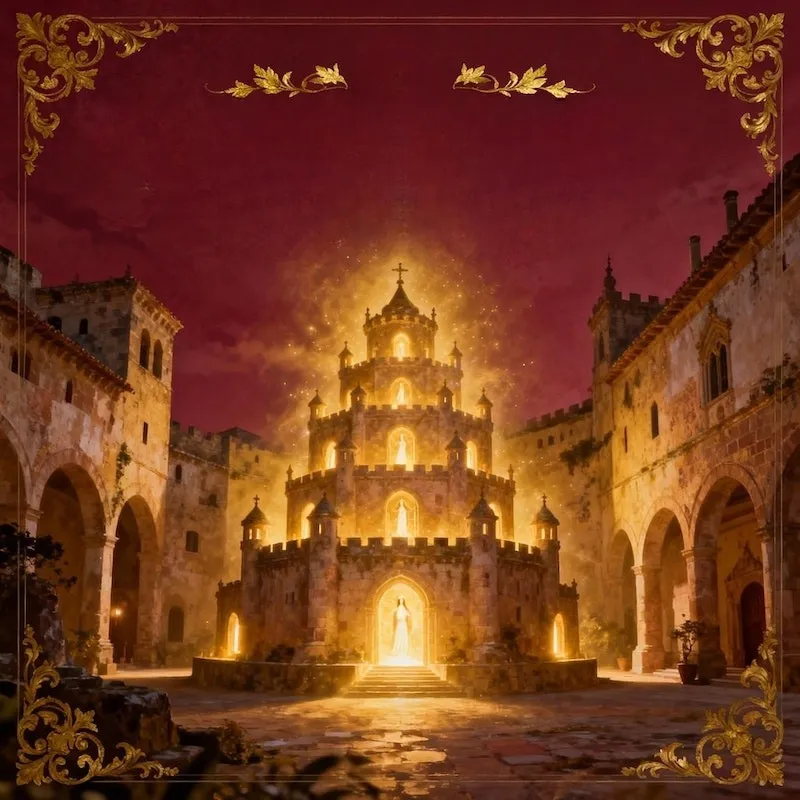
Written in 1577 by Saint Teresa of Ávila, The Interior Castle (Las Moradas) is one of the universal pinnacles of Christian mysticism. Through the allegory of a splendid diamond castle with multiple dwelling places, the saint guides the soul from the gate of prayer to the central sanctuary where the Holy Trinity resides, uniting sublime contemplation with fruitfulness in the loving service of Martha and Mary.
Chapter 1 excerpt
The soul is a splendid castle inhabited by God at its center. Through prayer and self-knowledge nourished by divine grandeur, man begins to tear himself away from the venomous beasts of worldly attachments.
Entry into the First Mansions marks the soul's fundamental awakening to its own grandeur and its present misery. Teresa first marvels at the unheard-of dignity of the human being: created in the image and likeness of the Most High, the soul is called to a relationship with God that surpasses what it can give itself. However, the saint vehemently laments the blindness of men who devote all their care to adorning a perishable body while totally neglecting this interior palace inhabited by the Creator. Persons in this first enclosure have begun to pray, but they remain almost entirely entangled in temporal affairs, earthly ambitions, and the vanities of the age.
The door of prayer thus opens through conscious recollection. Praying does not consist of mechanically reciting vocal formulas without knowing to whom one is speaking or what one is asking; prayer demands the attention of the heart, an awareness of God's presence, and a gradual renunciation of useless curiosities. Souls in the first mansions are invited to flee dangerous occasions, not to presume upon their strength, and to understand that the path will be a long struggle against the inertia of the flesh and the illusions of the devil.
 ORHAR Editions summary
Shared Christian heritage · 1418
Among all the treasures of Christian spirituality, no book—save the Holy Scriptures themselves—has exerted a more universal and enduring influence than The Imitation of Christ. Primarily attributed to the Canon Regular Thomas à Kempis (c. 1380–1471), this work emerged within the spiritual renewal of the Devotio Moderna, a movement born in the Low Countries at the close of the Middle Ages. Its purpose was to restore Christian faith to the purity of the Gospel, free from abstract theological disputes and worldly decadence. Unlike a theoretical treatise, The Imitation is a practical guide to intimate communion with the Lord. Its core message is deceptively simple yet profound: the sole worthiness of existence lies in following Christ in truth, detaching the heart from fleeting worldly vanities to anchor it in the eternal love of God. Structured into four thematically unified books, this masterpiece leads the reader from outward renunciation to the heights of Eucharistic intimacy, teaching the supreme art of inner peace: finding joy in humility, bearing one’s daily cross with patience, discerning the subtle snares of self-love, and surrendering wholly to the grace of the Savior.
Chapter 1 excerpt
The Imitation of Christ opens with a call to follow Christ in order to leave darkness behind and discern the vanities of the world.
The opening of The Imitation of Christ resounds as a vigorous call to clarity: « He who follows me walks not in darkness, says the Lord. » These words of Christ warn us that we must imitate His life and manner if we are to be truly enlightened and freed from every blindness of the heart. From the outset, Thomas à Kempis invites the soul to weigh the fragility of earthly securities against eternity. Taking up the cry of Ecclesiastes, he proclaims: « Vanity of vanities, all is vanity, except to love God and serve Him alone. »
What is vanity for the spiritual author? It is to seek perishable riches and place hope in them; it is to chase worldly honors and strive for a high rank; it is to follow the desires of the flesh, which prepare future punishments; it is finally to desire a long life without caring for a holy life. The worldly man lives in a perpetual illusion because he clings to what passes away, forgetting the Infinite toward which he journeys.
 ORHAR Editions summary
Orthodox spirituality · 1881
A universal classic of Orthodox spirituality, composed in 19th-century Russia. Through the wanderings of a solitary pilgrim, equipped only with his knapsack, the Bible, and the Philokalia, this initiatory narrative unveils the royal path of ceaseless prayer and the Prayer of the Heart ("Lord Jesus Christ, have mercy on me"), capable of pacifying the mind, illuminating creation, and transfiguring all human existence.
Chapter 1 excerpt
The resounding impact of the apostolic commandment to pray without ceasing, the ardent quest for a spiritual guide, and the decisive encounter with the holy starets teaching the Jesus Prayer.
The pilgrim's adventure opens with perplexity: hearing the command to pray without ceasing proclaimed in church, his mind remains haunted by this demand. He consults priests and listens to sermons. The clerics merely extol the usefulness of prayer or maintain that good works are equivalent to perpetual prayer. The traveler cannot be satisfied with this: according to the Fathers, interior prayer is the root from which true virtues spring; without it, human action quickly sinks into agitation or self-satisfaction.
The starets opens the Philokalia (Dobrotolyubiye) and reveals to him the tradition of the Desert Fathers. He teaches him the Jesus Prayer: 'Lord Jesus Christ, have mercy on me' (or in its full form: 'Lord Jesus Christ, Son of God, have mercy on me, a sinner'). This brief formula condenses the evangelical faith: it confesses the Savior and inclines the soul to humble contrition. The starets gives him a knotted wool prayer rope (chotki) and prescribes a rule: to repeat the prayer three thousand times a day in the quiet of his cell.
 ORHAR Editions summary
Anglican & Protestant · 1939
A masterpiece of Christian theology and an ecclesial testament penned in 1938 by Dietrich Bonhoeffer, a martyred Lutheran pastor and theologian. Born from the experience of the Confessing Church's clandestine seminary at Finkenwalde, this work unfolds communal life not as a human ideal, but as a divine reality received in Jesus Christ under the authority of the Word.
Chapter 1 excerpt
Christian community as a divine reality in Jesus Christ, the need for the Word proclaimed by a brother from outside (extra nos), and the mediation of the Savior.
From the very first pages, Dietrich Bonhoeffer dispels a misconception: Christian community is not an ideal that believers build by their own strength; it is a spiritual reality already accomplished in Jesus Christ. Too often, brotherhood is approached as an association of pious souls united by natural sympathy or spiritual affinities. Such an approach is illusory. The Church does not rest on human inclinations, but on divine election and the reconciliation wrought on the Cross.
Firstly, the Christian needs his brothers because he needs Christ. Salvation does not reside in the subjective depths of the human heart. Fallen man is curved in on himself (incurvatus in se), exposed to doubt and self-justification. The Word of reconciliation must reach him from outside (extra nos). It must be proclaimed to him by an external voice, by a brother who becomes the messenger of grace. The believer finds in his brother what he cannot draw from himself: the certainty of justification by faith.